 Fraunhofer Institute for High Frequency Physics and Radar Techniques FHR
Fraunhofer FHR presents SCaRL at EuMW 2025: A new multimodal benchmark dataset for autonomous driving
The Fraunhofer Institute for High Frequency Physics and Radar Techniques FHR will showcase a new development for autonomous driving at the European Microwave Week 2025 (EuMW) in Utrecht, Netherlands. With SCaRL, the institute presents a comprehensive synthetic dataset that synchronized radar, LiDAR, and camera information with unprecedented precision. The goal is to significantly enhance the robustness of perception systems and advance research in sensor fusion and radar signal processing.
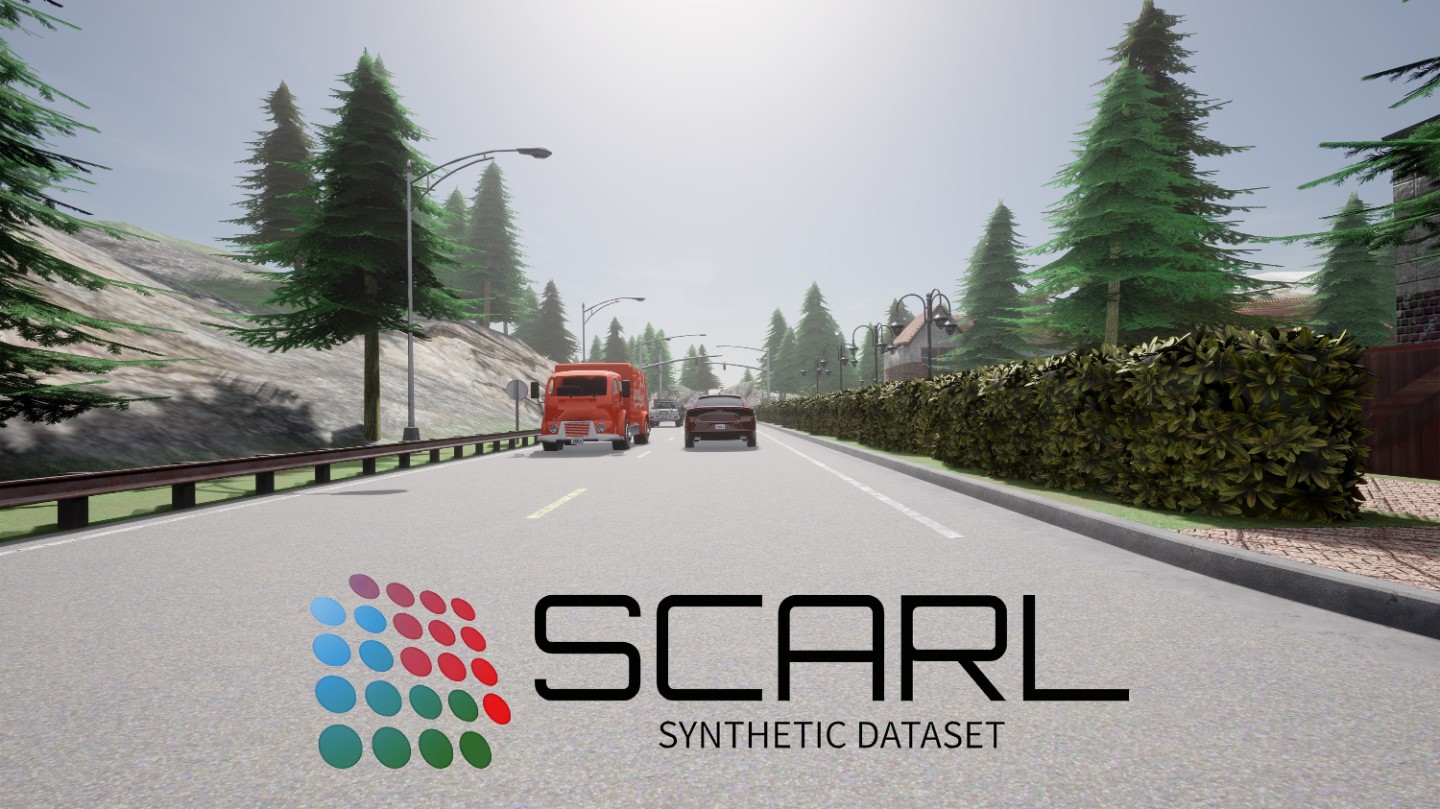
SCaRL was developed by Dr. María A. González-Huici, Head of Signal and Information Processing Department, and her team at Fraunhofer FHR to create a previously missing foundation for research and development in sensor fusion and radar perception in complex dynamic scenarios. "By combining realistic radar data with synchronized lidar and camera modalities, we are closing a crucial gap in multimodal signal processing research. Our approach enables the training and validation of advanced algorithms and supports the development of safe autonomous vehicles through comprehensive, flexibly customizable synthetic datasets," explains Dr. González-Huici.
The technological foundation of SCaRL is an extended version of the open-source simulator CARLA, originally developed for research in autonomous driving. Building on this, SCaRL generates synchronized data streams from RGB, semantic, instance, and depth cameras, coherent LiDAR, as well as extensive radar data from dynamic road scenarios. This includes not only raw data but also range-Doppler and range-azimuth/elevation maps. SCaRL thus goes far beyond existing datasets, which often only provide partial radar information. With this tool, researchers can now train and validate AI models for object detection, classification, and tracking, develop new sensor fusion methods and test complete perception pipelines under varying traffic and environmental conditions.
At EuMW 2025, Fraunhofer FHR will present an interactive demonstration of SCARL. In the live demo, visitors can experience synchronized modalities such as RGB video data, lidar point clouds, and radar projections side by side.
Concrete steps are already planned for further development of SCaRL. In near future, the dataset will be enhanced with multipath propagation and material-dependent radar signatures to better reflect reality. Additionally, there are plans to expand the simulator to other mobility domains such as aviation and rail transport. An additional visualization tool or software development kit will provide researchers and developers with an even more powerful tool. A subset of the dataset will be made publicly available, while licensing-based offerings will be developed for research and industry.
Alongside SCaRL, two complementary tools are also being developed: the SCaRL Radar Simulator, which allows users define arbitrary radar configurations - including sensor parameters, waveforms, antenna arrays/MIMO topologies, and processing chains - and generate customized radar datasets synchronized with multimodal (LiDAR and camera) data; and the SCaRL Scenario Generator, which enables the creation of tailored traffic environments for training and validation. Together, these solutions not only provide access to high-quality, fully synchronized datasets but also offer the flexibility to adapt scenarios and radar data to specific research and development requirements.
Get a closer look at SCaRL by visiting our booth B071 from September 23 to 25, 2025, as well as the Terahertz.NRW booth A049 at EuMW. The EuMW is the largest HF and microwave exhibition in Europe and is held in conjunction with innovative conferences and forums. Fraunhofer FHR will be present with more than 20 talks and posters, including an Industrial Keynote on "Industrial Applications of Terahertz Technology: A Fraunhofer View" featuring our Institute Director Prof. Dr. Dirk Heberling, along with Prof. Dirk Nüßler, Head of Industrial High-Frequency Systems (IHS), and Christoph Reising, Head of the Project Management Office (PMO).